Overview of DEI Group
The Ecological Forecasting Initiative recognizes that a diverse community brings different expertise and experience towards ecological forecasting; we see such diversity as a benefit, and necessary to the development of a diverse and inclusive community of interest and practice. Thus, we welcome all participants, and encourage patience and tolerance among all, holding curiosity and respect as the cornerstones of personal and professional growth.
An iterative approach works not only in the process of ecological forecasting, but if we adopt a mindset to continually engage with people of different backgrounds, get input, revise our efforts, we will become a more diverse community.
The EFI DEI Working Group Strategic Plan, posted in May 2020, provides an overview of the steps the DEI Working Group is taking to promote diversity, accessibility, and inclusion in EFI.
DEI Working Group Schedule of Calls:
The DEI Working Group will meet on Fridays at noon on July 12 and August 16. A new schedule of calls will be developed for September to December 2024. We are always open to people joining the calls, contact us at eco4cast.initiative@gmail.com
Book Clubs
The EFI DEI Working Group hosts Book Clubs that read books on topics relevant to diversity, equity, and inclusion academia, science, and ecological forecasting. Typically the groups meet in June-July each year.

This year, the group met in May 2024 to read Stolen by Sámi author Ann-Helén Laestadius to prepare for the EFI 2024 Conference in Helsinki, Finland. While the novel is based in Sweden, it centers the Sámi people who live across Norway, Sweden, Finland, and Russia. We are excited about this book, as it expands the book club in a few ways. This is the first novel the EFI book club will read. Much of the material that the DEI working group has focused on up to this point has had a United States bias and we expect reading and discussing Stolen together will provide the group with a contemporary view of cultural and environmental threats to an Indigenous group outside the U.S. We are also excited that in April of this year, Netflix will be releasing a film adaptation of Stolen, which could provide additional opportunities for discussion.
In October 2023 the DEI Working Group created this living document to provide a summary of action items suggested during book club calls. The living document is to be used as a reference to support and inspire activities for EFI that can be developed and led as individuals have time, availability, and interest in doing so. The living document also provides an opportunity to collate and celebrate activities that have taken place that have been inspired by or align with suggestions from the book clubs.
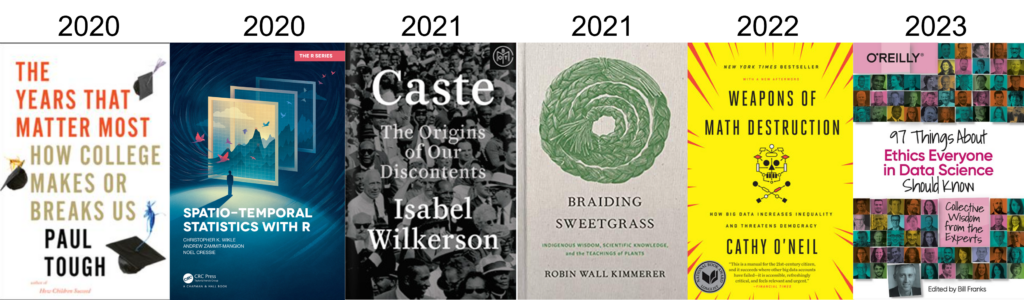
In 2021 the Book Club group participants who read Braiding Sweetgrass by Robin Wall Kimmerer developed this statement as a guide for considering data and forecast provenance. “Ecological forecasts, and the data that shape them, are a gift from the community. In this context, the community includes humans, animals, plants, and the land. Forecasts help us to shape decisions that impact our collective community or cultural values in a collaborative framework. We show gratitude for the gifts of ecological forecasts and data when we honor the reciprocal relationships among community members.”
Previous books include:
DEI Resources and Blog Posts
Blog Posts
- The EFI DEI Strategic Plan: What Have We Learned in 4 Years? – posted June 7, 2024
- From Communities to Topologies, Forecasting is a Social System – posted January 20, 2024
- EFI Book Club Suggestions & Actions Items – posted November 27, 2023
- Barriers to Inclusivity in Ecological Forecasting – posted May 17, 2023; updated June 9, 2023 with the Spanish Translation
Conversations on Diversity and Data Seminar Series
The EFI Diversity, Equity, and Inclusion Working Group hosted a 4 part virtual seminar series to foster conversations, actions, and making community connections that help promote diversity within ecological forecasting. The 4 session topics and links to recordings of the panels and resources shared are listed below.
- What do diverse students need to thrive in data- and computer-heavy settings? November 19, 2020 at 2pm US Eastern time
- A recording of this panel and the Q&A are available here.
- What does culturally competent data science training look like? January 20, 2021 at 12pm US Eastern time.
- A recording of this panel and resources shared during the panel are available here.
- How can 4-year data-driven institutions and programs support students transferring from community colleges? February 19, 2021 at 1pm US Eastern time
- A recording of this panel and resources are available here.
- What kind of online tools are useful and work well for remote learning and teaching? March 25, 2021 at 1pm US Eastern time.
- A recording of this panel and resources are available here.
Bibliography
This Bibliography is a living document that provides resources for learning more about anti-racism and the diversity status of fields relevant to ecological forecasting. These resources include lists of minority supporting associations, links to diversity and inclusion plans from professional societies, blog posts, publications, and compiled lists of resources from other organizations. If there are additional resources you have found useful, submit them through this Google form.
You can find the publications in the Bibliography tagged as “EFI DEI Paper” in the publicly-open Ecological Forecasting Initiative Bibliography Zotero group library
Blog Post and Video Resources
- Blog Post: Barriers to Inclusivity in Ecological Forecasting, May 17, 2023
- Blog Post: Diversity with EFI and How You Can Get Involved, June 18, 2020
Notes from Working Group Calls
Co-Chairs: Diana Dalbotten (University of Minnesota), Jason McLachlan (University of Notre Dame)
- April 19, 2024
- March 22, 2024
- February 23, 2024
- January 19, 2024
- December 18, 2023
- November 20, 2023
- October 16, 2023
- September 18, 2023
- August 14, 2023
- July 17, 2023
- June 12, 2023
- May 9, 2023
- April 11, 2023
- March 14, 2023
- February 14, 2023
- January 10, 2023
- December 7, 2022
- November 9th, 2022
- August 11th, 2022
- July 14th, 2022
- June 16th, 2022
- May 6, 2022
- April 8, 2022
- March 11, 2022
- February 4, 2022
- December 14, 2021
- November 16, 2021
- October 19, 2021
- September 28, 2021
- August 19, 2021
- July 15, 2021
- June 17, 2021
- May 17, 2021
- April 12, 2021
- March 22, 2021
- February 22, 2021
- January 25, 2021
- December 11, 2020
- November 20, 2020
- October 23, 2020
- September 25, 2020
- August 25, 2020
- July 28, 2020
- June 30, 2020
- June 2, 2020
- May 5, 2020
- March 30, 2020
- March 2, 2020
- November 21, 2019
- October 31, 2019
- September 17, 2019 – joint DEI and Education Working Group call
- July 12, 2019 – joint DEI and Education Working Group call