October 21, 2026
This fourth installment of the ongoing “Early Career Forecaster Spotlight” series spotlights Dave Klinges, an Assistant Professor in the Department of Ecology, Evolution, and Natural Resources at Rutgers University (USA).
The Early Career Forecaster Spotlight series is run by EFI’s Student and Early Career Association (EFISECA) and highlights early career forecasters to learn about their journey and work within ecological forecasting and to share knowledge and tips for those interested or currently working in the ecological forecasting field. If you would like to nominate an early career forecaster to be interviewed, please do so using this form.
Here is the link to all the posts in the “Early Career Forecaster Spotlight” series.
- How did you get introduced to ecological forecasting?
Before I started my PhD, I was a Research Technician at the Smithsonian Environmental Research Center (SERC), working with Jim Holmquist and Pat Megonigal (among many others) on the Coastal Carbon Network, a project to develop a clearinghouse and community of practice around quantifying and understanding carbon stocks in coastal ecosystems. Jim was becoming an expert in ecological forecasting, and introduced me to some core concepts. We both attended the first EFI conference in DC in 2019, which opened the doors to the EFI community for me. I dove in, volunteering to become one of the inaugural EFISECA Co-Chairs, and never looked back!
- What are your current research or academic interests and how do they relate to ecological forecasting?
My research program is an exploration of how climate change and land use change interactively impact biodiversity, with a focus on terrestrial and aquatic microclimates: the near-surface thermal, hydric, and radiative conditions that organisms actually experience. I use models and observations to understand and predict microclimates, and how species respond to their energetic environment. My group pairs remote sensing, weather reanalysis, mechanistic micrometeorological models, and plant / animal models to develop near-term forecasts of microclimate and how it shapes ecology and evolution. Some of our forecasting projects include attempting to understand how soil moisture influences crop hydric stress, and testing how amphibian phenology changes jointly due to the local environment and functional traits.
- What motivates you in ecological forecasting? If applicable, are there any stakeholders or end-users you work with?
I love that forecasts, especially near-term forecasts, allow us to test our predictions and models with truly out-of-sample new observations – the soon-to-be present day that we haven’t yet lived. The forecasting framework also lends itself to hypothesis testing and attributing uncertainty to different sources, which I think are cool ways to deploy the scientific method. For some of our projects, we work closely with protected area managers and farmers in Madagascar. For such partners, it can be important and useful to have access to near-term forecasts, and understand why such forecasts perform well (or don’t), including for scenario planning.
- What are the key lessons you have learned in your ecological forecasting work?
Improving understanding can oftentimes be better than improving prediction accuracy! For the types of questions I’m interested in, at least. Our forecasts might not always perform well, but if we can better understand a system or process by checking out what substantially changes the nature or values of our forecasts, that’s potentially quite useful.
- What is the biggest challenge you have faced in ecological forecasting and how did you overcome it?
My first few years involved with EFI, I felt like many of the folks I interacted with were way smarter than me and were better modelers and statisticians – in fact, I still feel that way. That was unnerving as a PhD student. But now I feel comfortable with the fact that I still have so much to learn. And the EFI community is so welcoming, it’s a great setting to learn in!
- What do you want to share with folks interested in becoming involved with ecological forecasting (e.g., resources, advice, etc.)?
The EFI Youtube channel is such a cornucopia of useful resources – I especially recommend the EFI Short Course playlist and the Fundamentals of Ecological Forecasting playlist. Then, for a resource closer to my research sphere – for those interested in spatial ecology, I strongly recommend Fletcher and Fortin 2026 (Spatial Ecology and Conservation Modeling Applications with R Spatial Ecology and Conservation Modeling Applications with R latest edition).
- Optional fun question! Do you have a special or favorite place from your research, travels, or education?
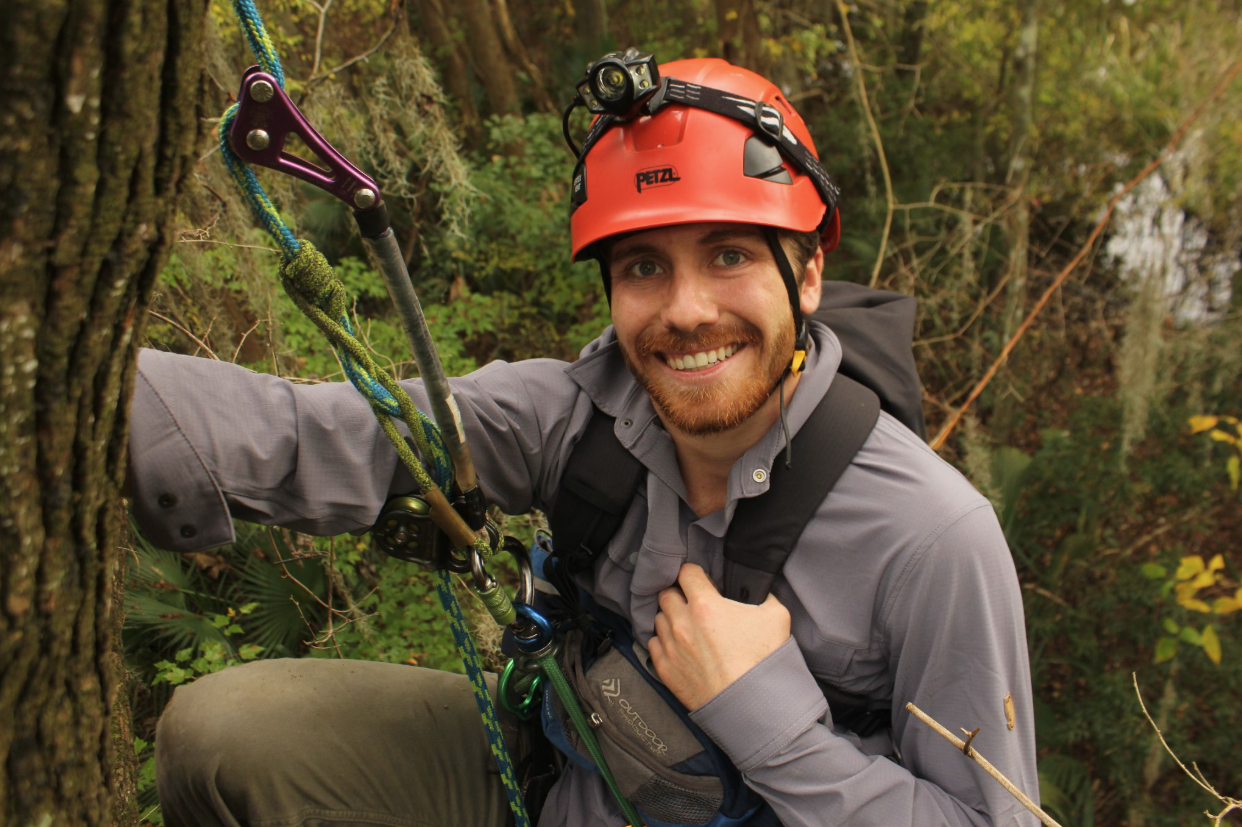
From a young age, I was obsessed with Madagascar given its tremendous and unique biological, geographic, and cultural diversity. It’s been a privilege to be able to work there since the beginning of my PhD, and learn so much from Malagasy friends and colleagues. Our research has involved climbing trees to understand the vertical niches of arboreal amphibians (e.g., see photo for tree climbing attire), quantifying how local community members can augment biodiversity records in Malagasy protected areas, and tracking radiated tortoise abundance with respect to long-term climate change. I’m looking forward to helping cross-pollinate insights between ecological forecasters across continents!